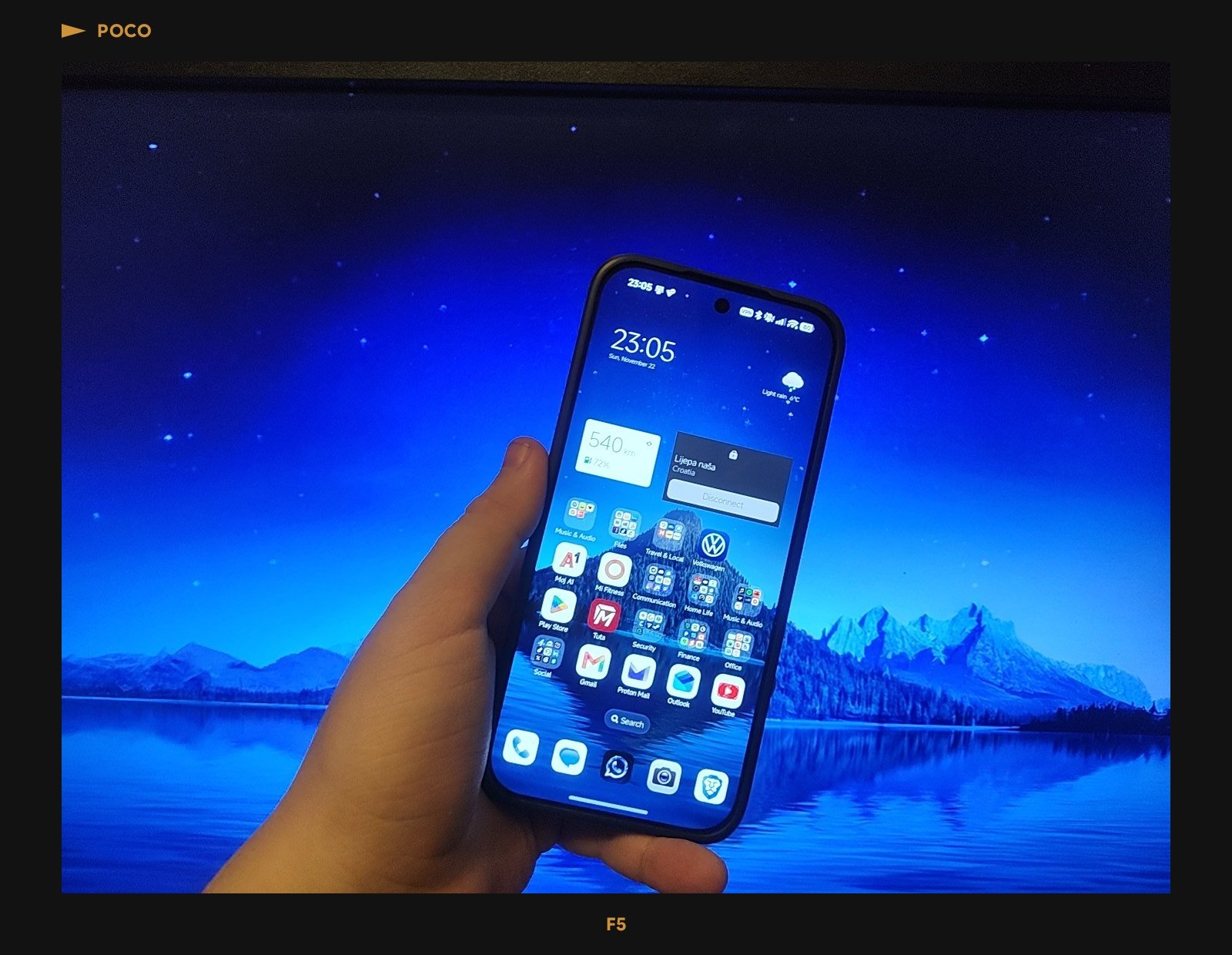
So, after three years of using Poco F5, and losing support of that device officially from Xiaomi I went into shopping decision spree - having options which are needed to stay out be improved, some things which are good to know and also - nice to have options.
In my budget which was up to 600€ and need to upgrade there was 2 important things - eSIM support and long device support from provider, while good things to be improved are obviously specifications like storage, battery, SoC, RAM and even charging speed. Nice to have options were brighter display and keeping at least 120Hz display in AMOLED as with Poco F5 it got to me.
This got me to - Poco X8 Pro Max and Poco F8 Pro in choices. My first go to was X8 Pro Max, but sadly it was fast seller and first order of it was cancelled so I had to decide - get Xiaomi 17T or even getting to Poco F8 Pro. After some deliberation got to Poco F8 Pro as it is like smaller flagship like Poco F8 Ultra which was my third even bit more expensive option which had also one option which I dismissed - Wireless Charging.
Other good things from this device is Snapdragon 8 Elite Mobile SoC which is 90% flagship but without pricing of same. 12GB of RAM with automatic extension with 6GB virtual RAM for me is enough, and man, 512GB ROM storage is chef's choice. Even 256GB would be fine, but 512GB and this specs paid 600€ without special discount is great directly from Xiaomi Croatia official retailer - mi.hr, run by Bjelić Ltd from Osijek, the official Xiaomi redistributor for Croatia.
Small sadness on the side - device comes in Black, Blue and Titanium Silver, but when I wanted to buy it only Black was available locally. Blue would have been my pick, Silver close second, but hey - it lives in a case anyway, and Black is stealth.
Now, to the meat and potatoes of the review: how it is to use the phone daily after almost five months. Short version - it is fast, it is smooth, and it made me forget the Poco F5 faster than I expected.
The Snapdragon 8 Elite is a proper flagship SoC - 3nm, Oryon cores, Adreno 830 - and with 12GB of RAM behind it everything from app switching to heavy browsing feels instant. Coming from the F5, which was no slouch itself, the difference is not only in fluidity, it is in headroom. The F5 slowed down over three years, and this one gives me confidence it will not, at least not in the same timeframe.
The display checks both of my "nice to have" boxes and then some. 6.59 inch HyperRGB AMOLED with full RGB subpixel structure, 120Hz, Dolby Vision and HDR10+ support, 2000 nits in high brightness mode and up to 3500 nits peak. Translation from marketing language - I can finally use the phone in direct sunlight without hunting for shade, which was one of my wishes coming from the F5. With 2560Hz PWM dimming it is also easy on the eyes at night, something I did not know I needed until I had it.
Sound - Bose did its homework
This deserves its own section, because the difference is not subtle. Symmetrical stereo speakers tuned by Bose, with Dolby Atmos and Hi-Res audio support, are a generational jump from the F5. Here is my rough comparison - at around 30% volume, the F8 Pro delivers sound that is fuller and louder than the F5 pushed to 80%. That Bose tweaking did magic. I tested it properly during sports season - watching matches through my ISP's mobile TV app, at about 30% volume, without cupping the phone or huddling around it. Put it on the bed and it is loud, simple as that. Media, calls and navigation prompts all sound full, and I catch myself not reaching for headphones as often as before.
The IR blaster - quiet hero, third generation in a row
One additional "nice to have" that never made it onto my wishlist - because I just assumed it would be there, as it always was. From Redmi Note 9 Pro, through Poco F5, until now with Poco F8 Pro - the IR blaster is a savior. I will not say for what and why in every scenario, but here is the one that earns it a permanent place: the living room TV remote is slowly dying inside, even after a few cleanings and regular battery changes, and refuses to turn the TV off. Just one damn button, just one. So - turn on the IR blaster, now with the camera side of the phone aimed at the TV, and voila: TV is off.
For turning on there is no need for it - the HDMI-CEC from the DVB-T2 set-top box does all the magic of waking the TV up and switching to the proper HDMI connection. But until that remote gets its next fresh cleaning a few weeks on, the IR blaster is the savior, every single time it acts up again. Small feature, decades of Xiaomi tradition, absolutely not giving it up.
Living with under-display fingerprint reader
This one needed a paragraph of its own, because after years of side-mounted readers - in Samsung Galaxy A7 (2018), then Redmi Note 9 Pro, then in the F5's power button, even for a short period of time on Realme 6s, and currently on my business phone Redmi 14C - it was the one change that actively fought me. On the F5 the sensor was right there, muscle memory level - touch to unlock, double tap for flashlight, double click for camera. The F8 Pro moves everything under the display with an ultrasonic reader, and it took me a while to stop tapping the power button expecting it to read my finger.
To be fair to the hardware - the ultrasonic reader is fast, it unlocks quickly, it even works with wet hands, and press-and-slide enrolment is a nice quality of life touch. But the transition is a real thing, especially the first weeks. And that brings me to the anecdote I promised.
The one thing that nearly broke me - bank app
Before I fully switched, there was one genuine annoyance - my banking app, or to be precise, my primary bank's long living app. Some history first: a year, maybe a year and a half ago (I really forgot at this point), the app already had issues with Poco F5 - some updates broke it, and I could not redownload and re-push it without going to the banking teller so they can push new activation codes. So when migrating to the F8 Pro, I knew the drill. One afternoon, about 20 minutes of waiting just to get my damn codes, and voila - the app is back, now updateable without issues.
Thankfully, I had backup plans as always: Curve Pay with my bank card in it so I could top-up Revolut, and in the bank they also activated Google Wallet for me. The twist is that Google Wallet was technically lost after resetting the Poco F5 - the old phone had to stay online until the old codes were removed, so the handover could happen properly. And once the bank finally released the F5 from its duties? Bootloader unlock time. I waited for exactly this moment, prepped everything, got the unlock ticket from Xiaomi - one day to move the app over, one more day to unlock it, and see ya on the F5, the bank app now lives on the F8 Pro. So as a side story: the F5 is now enjoying its custom ROM retirement, exactly as planned in the Software section below.
None of this was the phone's fault - just the reality of device-bound banking apps that make you jump through hoops when you change devices. If you are planning a device switch, do yourself a favor and prepare your bank app migration before you retire the old phone. Consider this my public service announcement of this review.
Connectivity - dual SIM tradition, now with eSIM superpowers
As always in my phone history: from Redmi Note 9 Pro, through Poco F5, to now Poco F8 Pro - all my phones are dual SIM. The difference is that the F8 Pro adds eSIM
compatibility on the second SIM option, which is - obviously - enabled. You can have multiple eSIM
profiles stored, but I have just one: a Bosnian HT Eronet pre-paid package. I use it when I need to go towards the Bosnian border, so my main (still physical) SIM card does not burn data on roaming or connect to the wrong towers and whoops - got invoice in hundreds of Euros. Not like currently with the package and a few add-ons, about 50€ for a full flat package including Netflix and IPTV as a combo on the family plan - otherwise the price would be higher (small digression: I have multiple phone numbers, my own and family members' linked, for that promotion).
5G - top notch. Tested in rural areas, on the outskirts of Zagreb and in Zagreb center: no issues, no drop-downs. Wi-Fi - again, no problemos. My current router runs 5GHz on Wi-Fi 6, and speeds are perfect - not like wired and what we get via wire on the PC, but still I cannot find a single complaint. Even with multiple devices downloading things at the same time, I can normally watch YouTube or a sports stream without buffering drama.
Best part? eSIM saved me a trip to gain a new physical SIM card for Bosnia whenever going through. Although, to be fair, one old device (khm, Redmi Note 9 Pro) is still dedicated to that old classic Roaming-only SIM card with cheap internet packages - and my provider offers the same thing, lol. Every phone in this house has a job.
And one more modern trick - the Interconnectivity feature of HyperOS 3.x and 4.x. Damn boy, this is good. Combined with the integrated Link to Windows, I can seamlessly (kind-of) copy photos over without getting my lazy ass to connect a cable to the PC. And via the downloadable Xiaomi Interconnectivity application, it works even on Apple devices - precisely my iPhone 13 Pro, old and second-hand, received from a family member. No hassle of pushing files through WhatsApp and friends: I can share images in full size and without compression between devices, or move data that needs to go somewhere else - ie. to the business phone, which does not have Interconnectivity at all. Which brings me to the "thanks, Xiaomi" of this section: the feature is limited to mid-range upwards devices, with no support for lower end ones - like my Redmi 14C (8/256GB in Dark Blue, for which I wrote a review earlier: Xiaomi Redmi 14C for business budget phone, serious value). Budget phones deserve interconnectivity love too.
Software - official updates and the community backup plan
The phone launched with Android 16 and HyperOS 3, and this is where the "long device support" part of my purchase decision gets its proof. As a Mi Pilot I already received the latest major update - Android 17 with HyperOS 4.0 - within these five months. Few words on it: smooth, following the current iOS look-alike design trend, but no issues at all and the apps are still top notch. As always with Xiaomi, some preinstalled applications are there for the ride - and thanks to Xiaomi, everything I do not need can simply be disabled. Clean enough for me.
Xiaomi officially promises 4 Android updates and 6 years of security updates, on a quarterly basis whenever possible, depending on regions - which was one of my two must-haves, and so far the delivery matches the promise. And this is not just marketing talk - Xiaomi's own Security Center lists the POCO F8 Pro with a concrete Security Update EOL Date: 2031-11-26. Exactly 6 years from the global release date of 26 November 2025, written down in black and white. That is the kind of paperwork I like to see before spending 600€.
Speaking of support endings - there is a community and custom ROM side to this story too. The scene already exists on XDA Developers for the Poco F8 Pro (and its sibling Redmi K90 - same phone, same release date, same update cadence, different nameplate for the Chinese market), and knowing how these things go, as a Snapdragon based device I expect the offering to grow further down the line. My plan is simple: ride the official updates until they are no more, and only then look into the custom ROM scene as the backup plan - the digital retirement plan for the device. For now, though? Nah - keeping it stock as possible. It worked for the F5, it will work for the F8 Pro.
Battery and charging - the star of the show
The 6210mAh battery is the star of this phone, no contest. My screen on time on daily basis averages 6+ hours, and that is on heavier messaging days - WhatsApp, Telegram, Facebook Messenger and Signal running constantly, plus mailing apps from Proton, Google and Tuta Mail stacked on top. Zero sync issues, and even letting all apps sync freely goes flawlessly. Push that usage down to moderate and the battery survives 2 full days without ever pulling the trigger on the charger. The Snapdragon 8 Elite being efficient helps here - performance went up, but it sips power in everyday tasks instead of gulping it.
About that trigger - the Xiaomi 100W Charging Combo (Type-A). Officially the F8 Pro charges to 100% in 37 minutes; in my daily reality, topping up while making coffee brings back more than enough for the evening. The phone also supports 100W PPS, so fast charging works with third-party chargers too, which is a welcome, less walled-garden approach than I expected. One thing to know - depending on local retail, the power adapter is not necessarily in the box, so I bought the official Xiaomi 100W Charging Combo (Type-A) separately from the same Xiaomi Croatia official store for about 20€. Bargain, and cheaper than most noname bricks pretending to be fast. GaN inside, 1-meter cable in the kit, and it speaks PD 3.0 and QC 3.0 - so it earns its place in my bag feeding other gadgets too.
But here is the kicker - legacy hardware works too. When I am not in a hurry, the old Poco F5's 67W brick and cable come out, and they are still perfectly capable of fast charging this phone. Bit slower, but hey, works for me. Especially during my lazy showers - the phone goes from about 20% to approximately 80% in 30 minutes while I take my sweet time. There is something poetic about the F5's charger feeding its successor every day, a nice little circle of Xiaomi life.
And 22.5W reverse wired charging occasionally saves my earbuds or someone else's phone. Smart charging, which throttles speed based on temperature and battery state, is on by default and I left it that way - long term battery health beats 5 saved minutes.
Camera - not all megapixels are same
Not all megapixels are same. Can I tell more? Do you need a 200 megapixel camera on a phone - or do you think I am insane going to 50 megapixels on my latest phone from the 64 megapixels on my two previous main devices? Nah. Sensor, OIS/EIS and video resolution were the deciders, not the number on the box.
The triple setup in practice: 50MP main with OIS on a 1/1.55" Light Fusion 800 sensor, a 50MP telephoto at 60mm (2.5x optical), an 8MP ultrawide, and a 20MP front camera. After using 4K video for 6 years across my last two Xiaomis and the iPhone, it was finally time to test 8K on a new device. Only thing to say after a quick test: damn. Even on my 1080p monitor, 8K is sharp as all heck - a bit sharper than 4K to my eyes, which should tell you everything about the sensor doing the heavy lifting. For daily recording, 4K with OIS is fine for me, 30 or 60FPS - minor thing, but 60FPS is waaay smoother even with OIS on.
The telephoto tells the same story as the main sensor: real optical zoom up to 2x, and even up to 5x sometimes with the hybrid zoom doing quality work (tested up to 8x on a few photos in the Gallery - usable, with quality loss visible but not embarrassing). Night shots and the front facing camera are perfectly decent for my usage - rare selfies, early morning and late night photos. Videos sadly did not get saved for this review, but if I add them, they will be in the gallery linked below.
Gallery is here - view it.
Conclusion - the verdict
New daily for next few years? Yes brother. The receipt says it all: POCO F8 Pro, 12GB + 512GB in Black, ordered on 14 August 2026 from the official Mi.hr store (Bjelić Ltd from Osijek, the official Xiaomi redistributor for Croatia) for 599.00€ plus shipping (with the added official GaN charger, still comfortably under what a new-gen F9 Pro with half the storage would cost today). Bonus points for delivery speed: ordered the day before a bank holiday, and it still arrived within 3 days from order to my hands. Fast work.
And now the kicker to Xiaomi, with receipts. Not even 2 weeks after my order - the Poco F9 series went global on 1 September 2026. Sorry, Xiaomi, for not waiting - but let us look at what waiting would have actually gotten me. The F9 Pro starts at 649.90€ (256GB) or 699.90€ for the 512GB variant - a specs bump and a price bump, exactly as suspected - and its video recording tops out at 4K, so no 8K there. To keep the 8K camera and similar specs, I would have to go with the F9 Ultra, which starts at 759.89€ - meaning the new generation Ultra with the same 8K capability costs even more than the older gen F8 Ultra, which was listed around 626.90€ and was already too expensive for my taste when I was deciding. Waiting two weeks would have meant paying more for a megapixel count I do not care about, while losing money on the feature I actually use. Nope.
The old F5 was ready to receive its kicking into reserve duty: de-Googled, without Google apps, running alternatives from Proton, Tuta, Aurora Store and F-Droid, destined to be my break-the-glass device with a pre-paid SIM. Not a main with a postpaid SIM anymore - it served its 3 years with honor.
So, is this "perfection of daily device - part 2"? Five months in - yes, with the verdict written in the same ink as the original: it is not chasing perfection, it is chasing longevity, and it is winning.
Notices
Written with help of AI - especially the Proton Lumo 2.0 Max model. Cover photo is made with my own Poco F5, of a Poco F8 Pro rocking Android 17 and HyperOS 4.0.